Audit fee rises: every firm is at about 5%
Across 14,618 UK companies with two consecutive audit fees on file, the median increase is 5.0%, and every one of the fifteen largest firms sits between 4.1% and 6.6%. Switching firm buys almost nothing on the annual uplift; the spread that matters is inside each firm, where 36.8% of clients were held flat and 20.3% were asked for more than 20%.
The uplift is the same wherever you go
Every UK company that files audited accounts discloses what it paid its auditor. auditor.ltd reads that line from every filing it can find at Companies House, cleans it and pairs each fee with the same company’s fee the year before. As of 10 September 2026 there are 31,677 clean fees on file, 14,618 of them matched into a pair, and the median change across those pairs is 5.0%.
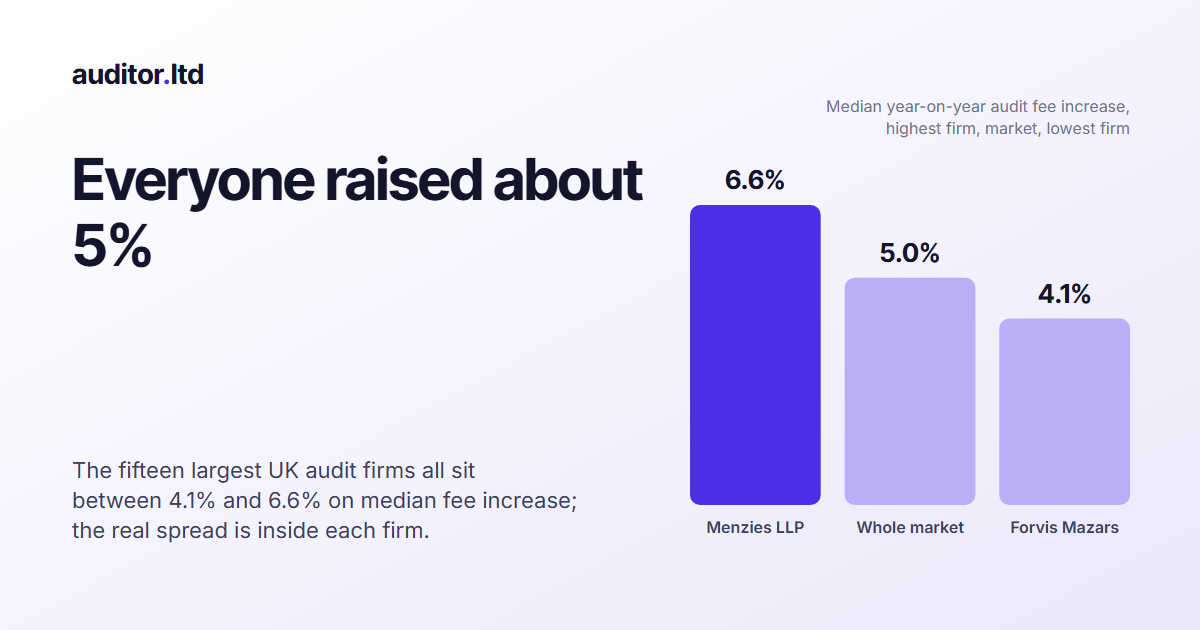
Set the fifteen largest firms by pair count side by side and the striking thing is how little separates them. Menzies sits at the top with a median increase of 6.6%. Forvis Mazars sits at the bottom with 4.1%. Everything else falls inside that 2.5-point band: Azets at 6.1%, DJH at 5.9%, Xeinadin and UHY Hacker Young at 5.3%, Johnston Carmichael at 5.1%, Sumer, Moore Kingston Smith, Cooper Parry and BHP all at 5.0%, Hazlewoods at 4.9%, TC Group at 4.8%, Saffery and Hurst at 4.7%.
For a company paying the national median fee of £15,000, the difference between the firm raising most and the firm raising least is 2.5% of the fee, or £375 in a year. That is not a reason to run a tender.
What the market did, in four groups
The 14,618 pairs divide into four behaviours, and they are not evenly sized.
| Change on last year | Share of companies |
|---|---|
| Up more than 20% | 20.3% |
| Up 5–20% | 27.8% |
| Flat | 36.8% |
| Down | 15.2% |
The largest single group did not move at all. More than a third of audited companies, 36.8%, paid their auditor the same figure they paid the year before, and another 15.2% paid less. Taken together, 52.0% of companies saw no increase. Against that, 20.3% were asked for more than 20%.
That is the shape that matters. The market does not apply an inflationary uplift across the book. It holds most fees still and moves a fifth of them hard.
The spread inside a firm dwarfs the spread between firms
If the medians are all alike, the tails are not. The share of each firm’s clients who took a rise of more than 20% runs from 11.7% at Forvis Mazars to 27.0% at DJH, a range more than six times as wide as the range in medians.
| Firm | Pairs | Median change | Share up over 20% |
|---|---|---|---|
| DJH Audit Limited | 159 | 5.9% | 27.0% |
| Xeinadin Audit Limited | 324 | 5.3% | 25.9% |
| Sumer Auditco Limited | 403 | 5.0% | 25.1% |
| Saffery LLP | 278 | 4.7% | 22.7% |
| Azets Audit Services | 810 | 6.1% | 20.1% |
| Hazlewoods LLP | 139 | 4.9% | 14.4% |
| Forvis Mazars LLP | 154 | 4.1% | 11.7% |
Sumer and Moore Kingston Smith share a median change of 5.0%, exactly the market median, yet a quarter of Sumer’s clients took more than 20% against a fifth at Moore Kingston Smith. Saffery has the fourth-lowest median in the fifteen, at 4.7%, and the fourth-highest tail, at 22.7%. A firm can hold its median at the market rate while repricing a quarter of its book, because the flat clients pull the median down and the repriced ones sit above it.
Four firms cluster at the top of the tail: DJH, Xeinadin, Sumer and Azets, at 27.0%, 25.9%, 25.1% and 20.1%, against 20.3% for the market as a whole. Three of those four are consolidators, and Accountancy Age described the private equity buy-and-build boom in the mid-tier as an era of “the ‘easy’ roll-up valuation” that has now hit a ceiling. Acquired books get repriced onto the acquirer’s rate card; that shows up as a fat tail rather than a high median.
Why a fifth of clients and not all of them
The filings do not say why any one fee moved, but the pattern is consistent with repricing decisions taken client by client. A fee that has not been reviewed for several years is caught up in one step. A first year after a change of auditor, where the initial fee was quoted keenly, is corrected at the second. A group that has grown through a revenue band gets priced for its new size: the median fee at £10–25m is £15,750 and at £25–50m it is £19,500, a step of 23.8% that arrives in one year if the company crosses the boundary in one year.
None of those is firm-wide policy. All of them are specific to a company, and all of them are answerable at the partner meeting. Sector and size medians are on the audit fees page if you want to see where your own fee should sit before that meeting.
What this means for a finance director
Two conclusions follow, and they point in opposite directions from the usual advice.
The first is that changing firm on the strength of the annual uplift is not supported by the data. The gap between the highest and lowest median increase among the fifteen largest firms is 2.5 percentage points. On a £15,000 fee that is £375, and on the £28,730 median at £100m or more of revenue it is £718. A tender costs more than that in management time before the first proposal arrives.
The second is that the level of your fee, as opposed to its annual movement, is still worth arguing about. The £10–25m band, the largest on file with 8,129 companies, runs from £10,500 at the lower quartile to £23,400 at the upper, a spread of £12,900 between companies of the same size. That spread is where the money is, and it is set at the point the fee is agreed, not at the annual review.
What to ask, and where to look first
If your fee rose more than 20% this year, you are in a group of one company in five, not in a market-wide adjustment. The question for the partner is specific: what changed in the engagement, what work was added, and what the fee would have been had nothing changed. If the answer is inflation and staff costs, the reply is that 36.8% of the market absorbed those same costs without moving the fee at all.
If your fee was held flat, the useful thing to know is that you are in the largest group, not that you have been overlooked. Fees that sit still for several years tend to move in one step when they do move, and a flat year is a reasonable moment to ask what the firm expects the next three years to look like.
Either way, start with the number rather than the movement. The benchmark puts your filed fee against companies of your size and sector. The firm-by-firm fee changes show where your auditor sits on both the median and the tail, and the data is downloadable as CSV if you want to run the comparison yourself.
Questions this article answers
How much did UK audit fees rise in 2026?
On the fees filed with Companies House and read by auditor.ltd as of 10 September 2026, the median change across 14,618 companies with two consecutive fees on file is 5.0%. That median hides a wide distribution: 36.8% of companies paid exactly the same as last year, 15.2% paid less, 27.8% went up between 5% and 20%, and 20.3% went up by more than 20%.
Which UK audit firm raised its fees the most?
On median change, Menzies LLP at 6.6% across 201 pairs, followed by Azets Audit Services at 6.1% and DJH Audit Limited at 5.9%. The lowest of the fifteen largest firms is Forvis Mazars LLP at 4.1%. On the share of clients taking a rise of more than 20%, the order is different: DJH leads at 27.0%, then Xeinadin at 25.9% and Sumer at 25.1%, against 11.7% at Forvis Mazars.
Should I change auditor because my fee went up?
Not on the increase alone. The gap between the firm with the highest median increase, 6.6%, and the lowest, 4.1%, is 2.5 percentage points, which is £375 a year on the national median fee of £15,000. The level of the fee is a better reason: among companies with £10–25m of revenue the lower quartile pays £10,500 and the upper quartile £23,400, a spread of £12,900 between businesses of the same size.